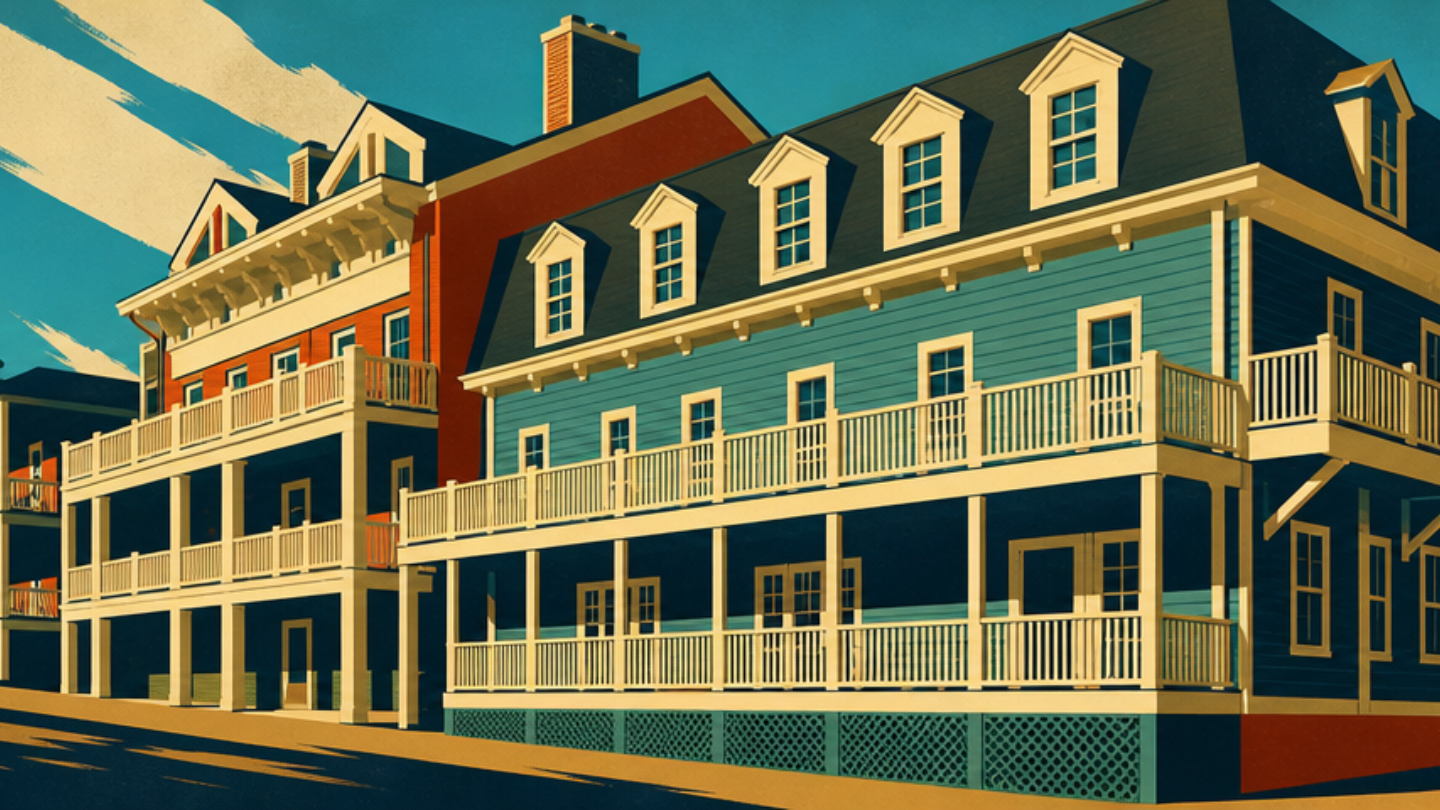
A man may travel the Hudson a good many times and still fail to notice that the river is a kind of long, slow argument between mountains. It is always going somewhere, and the mountains are always trying to keep it from getting there too quickly. At Cold Spring the argument pauses long enough for a village to take root, and at the very end of Main Street—number 2, if a street number still means anything in a place this old—stands an inn that has been listening to the same argument since Andrew Jackson was in the White House.
The building went up in 1827. Guests have been putting their hats on the pegs since 1832. That is not folklore; that is the house’s own accounting, and it matches the village records well enough. It first answered to the name Pacific Hotel, later Hudson View Inn, and now Hudson House River Inn. Names change. The river does not. The house sits about a hundred feet from the water, which is close enough that a man on the porch can smell the tide and still hear the train. From the river rooms a guest looks across to West Point and Storm King Mountain, two facts of geography that have outlasted every administration that ever tried to improve them.
Cold Spring itself is not an accident of scenery. After the War of 1812 the government wanted cannon it could trust. Gouverneur Kemble and company put an iron foundry on Foundry Cove, just south of the landing. Robert Parker Parrott—West Point man, later superintendent—gave the place its fame. The Parrott rifle, a cast-iron gun with a wrought-iron band around the breech, came out of those shops in 1860 and 1861. During the war the foundry turned out some two thousand cannon and three million shells. The village grew around the work: houses for the men, shops on Main Street, hotels at the dock. Local memory names Walter Simonson as keeper of the Pacific Hotel in those years, near the new landing. The inn was already there when the foundry was at its loudest. It is still there now that the foundry is a ruin in the woods.
In 1982 the building went onto the National Register of Historic Places with the rest of the Cold Spring Historic District, a stretch of Main Street and neighboring streets that the Register called one of the better-preserved nineteenth-century townscapes on the river. The inn claims, and the claim is widely repeated, that it is the second-oldest continuously operated inn in New York State. Continuity is a stubborn kind of virtue. The house has been enlarged and patched and painted, as any house that has lived through steam, rail, automobile, and wireless must be. Original details remain: the bones of the place, the way the rooms sit toward the water, the habit of hospitality that does not require a brochure to explain itself.
Today the house keeps eleven rooms and two suites. Some have balconies; some have walk-out terraces. The linens are modern. The views are not. Downstairs the River Room and the Half Moon Tavern do the work an inn has always done: feed the traveler and the neighbor alike. The kitchen, under executive chef John Guererro, deals in aged steaks, market fish, lamb, and the sort of regional plates that make sense when the river is in the window. The wine list has taken awards. None of this is mysterious. An old house that still earns its keep is simply a house that refused to become a museum.
A visitor can reach the door from Grand Central on the Hudson Line, walk under the tracks, and be on the porch in a block. From the city by car it is a little more than an hour if the Taconic behaves. The village on the walk up Main Street is still the foundry town in civilian clothes: antiques, brick, the bandstand, the water. The inn does not pretend to be older than it is, or younger. It was built when the river was the highway and the foundry was the reason men came. It stayed when both of those facts changed. That is the whole story, and it is enough.
Hudson House River Inn
2 Main Street
Cold Spring, New York 10516
(845) 265-9355
Hudson House Inn